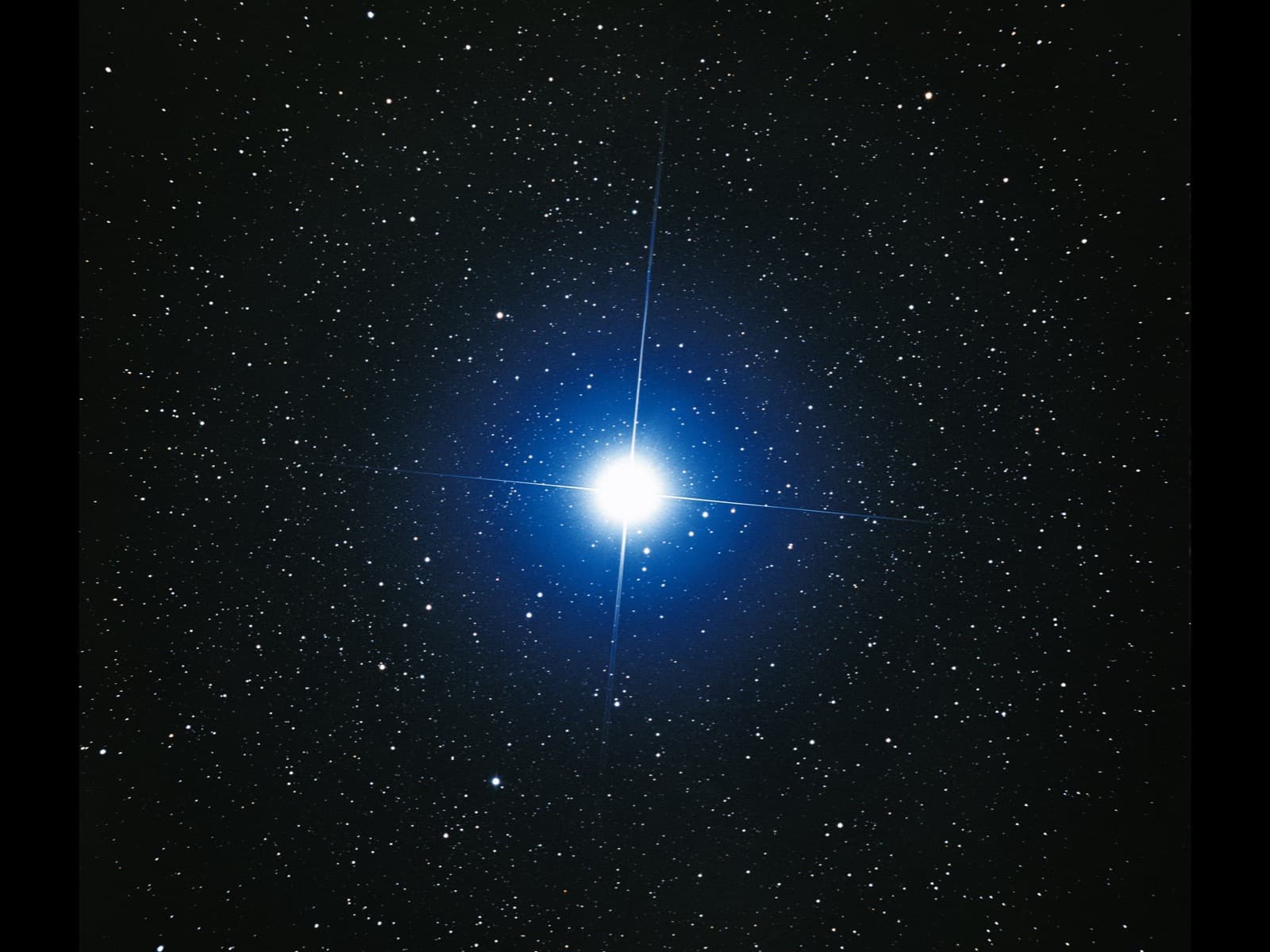
What is Sirius?
Sirius (Alpha Canis Majoris) is the brightest star in Earth's night sky, located approximately 8.6 light-years away in the constellation Canis Major — the Greater Dog. It is a binary system:
Sirius A — An A1V main-sequence star roughly twice the mass of the Sun and about 25 times more luminous. Apparent magnitude −1.46 makes it unmistakable on winter nights in the Northern Hemisphere.
Sirius B — A white dwarf companion nicknamed "the Pup," orbiting Sirius A every ~50 years. It was the first white dwarf discovered and remains one of the nearest known examples of a stellar remnant.
Type: A1V + DA2 (white dwarf)
Distance: 8.60 light-years
Constellation: Canis Major
Apparent magnitude: −1.46 (brightest night-sky star)
Sirius A — An A1V main-sequence star roughly twice the mass of the Sun and about 25 times more luminous. Apparent magnitude −1.46 makes it unmistakable on winter nights in the Northern Hemisphere.
Sirius B — A white dwarf companion nicknamed "the Pup," orbiting Sirius A every ~50 years. It was the first white dwarf discovered and remains one of the nearest known examples of a stellar remnant.
Type: A1V + DA2 (white dwarf)
Distance: 8.60 light-years
Constellation: Canis Major
Apparent magnitude: −1.46 (brightest night-sky star)
Why Sirius is the perfect near destination
Among Cosmic Echo destinations you can aim at from Station 1 today, Sirius sits in a sweet spot: closer than Vega, brighter than almost anything else in the sky, and famous across every culture that has ever looked up.
At 8.6 light-years, your signal arrives in under a decade. That is still interstellar — a real journey to another star system — but short enough that checking the Signal Tracker on birthdays and anniversaries feels personal. Send today, arrive before the next decade ends.
And because Sirius is naked-eye obvious, the destination never stays abstract. On clear winter evenings you can point to it and say: that is where the message is going.
At 8.6 light-years, your signal arrives in under a decade. That is still interstellar — a real journey to another star system — but short enough that checking the Signal Tracker on birthdays and anniversaries feels personal. Send today, arrive before the next decade ends.
And because Sirius is naked-eye obvious, the destination never stays abstract. On clear winter evenings you can point to it and say: that is where the message is going.
Ready to send your own words into the universe? Packages from $29 – printable certificate & live tracker.
Compose your messageThe Dog Star across human history
Sirius has been a calendar, a myth, and a navigational beacon for thousands of years.
Ancient Egypt — The heliacal rising of Sirius (Sothis) heralded the Nile flood and the Egyptian New Year. Temples and calendars were timed to its appearance.
Greece and Rome — The "Dog Star" of Canis Major, companion to Orion the hunter. Its summer rising was associated with the "dog days" — the hottest stretch of the year.
Modern astronomy — Sirius B's discovery helped prove that stars can leave behind ultra-dense remnants. Hubble later imaged the pair directly, with Sirius A deliberately overexposed so the faint Pup could be seen.
Sending a message to Sirius joins that long human relationship with the brightest point of light after the Moon and planets — not looking at it, but aiming words toward it.
Ancient Egypt — The heliacal rising of Sirius (Sothis) heralded the Nile flood and the Egyptian New Year. Temples and calendars were timed to its appearance.
Greece and Rome — The "Dog Star" of Canis Major, companion to Orion the hunter. Its summer rising was associated with the "dog days" — the hottest stretch of the year.
Modern astronomy — Sirius B's discovery helped prove that stars can leave behind ultra-dense remnants. Hubble later imaged the pair directly, with Sirius A deliberately overexposed so the faint Pup could be seen.
Sending a message to Sirius joins that long human relationship with the brightest point of light after the Moon and planets — not looking at it, but aiming words toward it.
Seeing Sirius tonight
In the Northern Hemisphere, Sirius dominates the winter sky. Find Orion's Belt — three bright stars in a short line — and follow that line southeast. The brilliant blue-white star you land on is Sirius. Nothing else nearby matches its intensity.
After you transmit through Cosmic Echo, that winter ritual changes. Every time Sirius rises, you know a radio signal carrying your words is already between here and there — 299,792 km farther every second.
After you transmit through Cosmic Echo, that winter ritual changes. Every time Sirius rises, you know a radio signal carrying your words is already between here and there — 299,792 km farther every second.
What the Signal Tracker shows for Sirius
Your Signal Tracker activates when transmission leaves Earth. For Sirius, the milestones stay human-scale:
1.3 seconds: Past the Moon
~4–5 hours: Leaving the solar system past Neptune
1 year: One light-year out
8.6 years: Signal arrives at the Sirius system
Share the tracker. Check it on the first anniversary. On the day it reaches Sirius, you'll know.
1.3 seconds: Past the Moon
~4–5 hours: Leaving the solar system past Neptune
1 year: One light-year out
8.6 years: Signal arrives at the Sirius system
Share the tracker. Check it on the first anniversary. On the day it reaches Sirius, you'll know.
~6 hours
To transmission
Radio signal
Transmission type
299,792 km/s
Signal speed
$29
Digital certificate
Frequently Asked Questions
Everything you need to know
Your words deserve to travel forever
Packages from $29 – printable certificate & live tracker. Your message transmits within hours.
Send Your Message