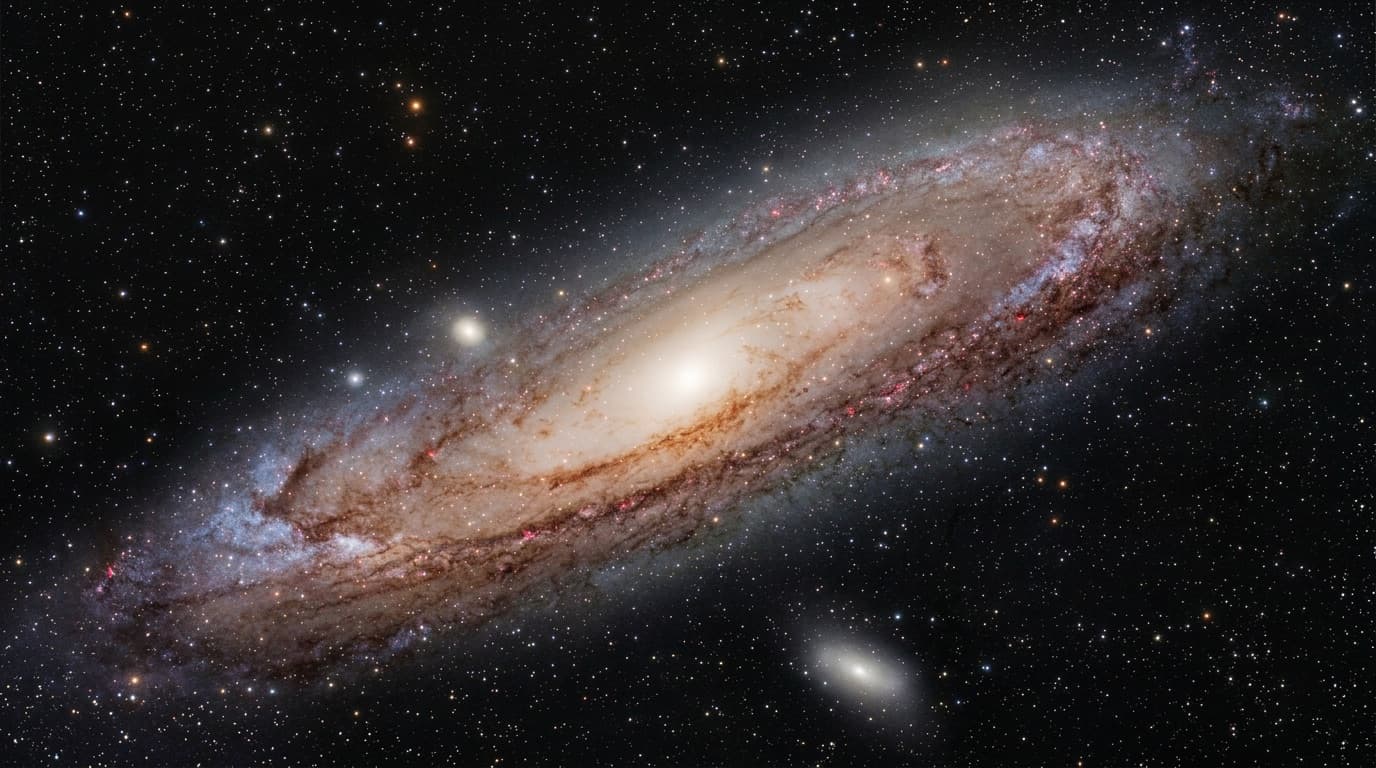
What is the Andromeda Galaxy?
The Andromeda Galaxy (also catalogued as M31 and NGC 224) is a barred spiral galaxy approximately 2.537 million light-years from Earth in the constellation Andromeda. It is the nearest large galaxy to the Milky Way and the most distant object visible to the naked eye under dark skies.
Key facts:
• Distance: 2.537 million light-years (about 2.4 × 10¹⁹ km)
• Diameter: ~220,000 light-years — more than twice the Milky Way
• Stars: ~1 trillion estimated — roughly 2–3× the Milky Way's stellar count
• Age: ~10 billion years
• Central black hole: ~100 million solar masses (much larger than our own Sgr A*)
• Companion galaxies: M32 and M110, two dwarf elliptical satellites
The Andromeda Galaxy has been observed by humans for thousands of years — Persian astronomer Abd al-Rahman al-Sufi described it in 964 AD as a "small cloud." Its true nature as a separate galaxy wasn't confirmed until 1924, when Edwin Hubble measured the distance to its Cepheid variable stars and proved it lay far beyond our own Milky Way.
Key facts:
• Distance: 2.537 million light-years (about 2.4 × 10¹⁹ km)
• Diameter: ~220,000 light-years — more than twice the Milky Way
• Stars: ~1 trillion estimated — roughly 2–3× the Milky Way's stellar count
• Age: ~10 billion years
• Central black hole: ~100 million solar masses (much larger than our own Sgr A*)
• Companion galaxies: M32 and M110, two dwarf elliptical satellites
The Andromeda Galaxy has been observed by humans for thousands of years — Persian astronomer Abd al-Rahman al-Sufi described it in 964 AD as a "small cloud." Its true nature as a separate galaxy wasn't confirmed until 1924, when Edwin Hubble measured the distance to its Cepheid variable stars and proved it lay far beyond our own Milky Way.
The Andromeda Collision — in 4.5 billion years
Andromeda and the Milky Way are approaching each other at approximately 110 kilometers per second. In about 4.5 billion years, they will collide and merge into a single, larger elliptical galaxy — sometimes nicknamed "Milkomeda" by astronomers.
Despite the scale of this collision, it will be surprisingly gentle for individual stars. The distances between stars are so vast that direct stellar collisions will be rare. The Sun and Earth will almost certainly survive the merger intact, though our position in the resulting galaxy will be dramatically different. The night sky will look nothing like it does today.
This collision is among the most significant known future events in the history of our solar system. It puts the 4.5 billion-year life of the Sun into perspective: roughly half of it has passed, and in the second half, our galaxy will transform beyond recognition.
Your signal, transmitted now at the speed of light, will reach the Andromeda Galaxy in 2.537 million years — long before any merger begins.
Despite the scale of this collision, it will be surprisingly gentle for individual stars. The distances between stars are so vast that direct stellar collisions will be rare. The Sun and Earth will almost certainly survive the merger intact, though our position in the resulting galaxy will be dramatically different. The night sky will look nothing like it does today.
This collision is among the most significant known future events in the history of our solar system. It puts the 4.5 billion-year life of the Sun into perspective: roughly half of it has passed, and in the second half, our galaxy will transform beyond recognition.
Your signal, transmitted now at the speed of light, will reach the Andromeda Galaxy in 2.537 million years — long before any merger begins.
Ready to send your own words into the universe? Packages from $29 – printable certificate & live tracker.
Compose your messageWhy Andromeda is unlike any other Cosmic Echo destination
Every other destination in our catalog is a single star or stellar remnant within our own Milky Way. Andromeda is something categorically different: an entire galaxy. A trillion stars. Millions of potential planetary systems. Possibly billions of worlds.
When you aim a message at Andromeda, you're not sending it toward one star — you're sending it toward the equivalent of an entire second Milky Way. The number of potential recipients — intelligent or otherwise — scales accordingly.
Andromeda also represents the outer boundary of gravitational attachment. The Milky Way and Andromeda are the two dominant members of the Local Group. Beyond the Local Group, galaxies are being carried away by cosmic expansion and will become unreachable over billions of years. Andromeda is our neighbor in the truest cosmic sense — and the furthest destination to which we are gravitationally bound.
When you aim a message at Andromeda, you're not sending it toward one star — you're sending it toward the equivalent of an entire second Milky Way. The number of potential recipients — intelligent or otherwise — scales accordingly.
Andromeda also represents the outer boundary of gravitational attachment. The Milky Way and Andromeda are the two dominant members of the Local Group. Beyond the Local Group, galaxies are being carried away by cosmic expansion and will become unreachable over billions of years. Andromeda is our neighbor in the truest cosmic sense — and the furthest destination to which we are gravitationally bound.
What the Signal Tracker shows for Andromeda
The scale involved makes the Andromeda Signal Tracker uniquely humbling. Your message leaves Earth at the speed of light, and the tracker begins immediately. The milestones:
1.3 seconds: Past the Moon
8.3 minutes: Past the Sun
~4.5 hours: Past Neptune
4.37 years: Passes Alpha Centauri
1,000 years: ~1,000 light-years out — a tiny fraction of the Milky Way
2.537 million years: Reaches the Andromeda Galaxy
The tracker updates in real-time, every second. Check it a decade from now and see how far your message has traveled into intergalactic space — an unimaginable distance, still growing.
1.3 seconds: Past the Moon
8.3 minutes: Past the Sun
~4.5 hours: Past Neptune
4.37 years: Passes Alpha Centauri
1,000 years: ~1,000 light-years out — a tiny fraction of the Milky Way
2.537 million years: Reaches the Andromeda Galaxy
The tracker updates in real-time, every second. Check it a decade from now and see how far your message has traveled into intergalactic space — an unimaginable distance, still growing.
~6 hours
To transmission
Radio signal
Transmission type
299,792 km/s
Signal speed
$29
Digital certificate
Frequently Asked Questions
Everything you need to know
Your words deserve to travel forever
Packages from $29 – printable certificate & live tracker. Your message transmits within hours.
Send Your Message