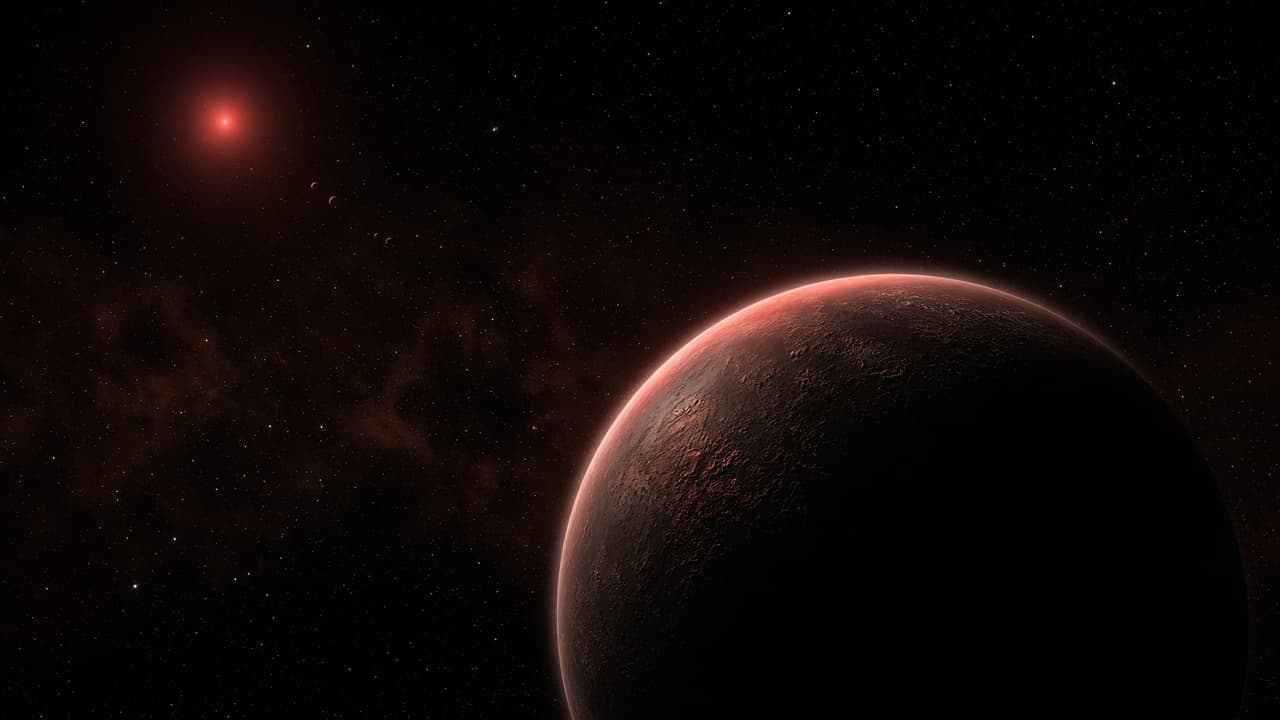
The most remarkable planetary system we know of
TRAPPIST-1 is an ultra-cool red dwarf star in the constellation Aquarius, approximately 40 light-years from Earth. It is slightly larger than Jupiter, with about 9% of the Sun's mass and 12% of its radius. By stellar standards, it is tiny and dim — but it is orbited by seven confirmed Earth-sized planets, making it the most densely packed compact system of Earth-sized worlds ever discovered.
The system was first identified as having planets in 2016 by the TRAPPIST telescope (Transiting Planets and Planetesimals Small Telescope) at La Silla Observatory in Chile. The full seven-planet architecture was announced by NASA in February 2017 in a high-profile press conference — one of the most widely covered astronomical discoveries in recent memory.
Key facts about the star:
• Distance: ~40 light-years
• Stellar type: M8V (ultra-cool red dwarf)
• Mass: ~0.089 solar masses
• Age: 7.6 billion years — older than our Sun
• Known planets: 7, all roughly Earth-sized
The system was first identified as having planets in 2016 by the TRAPPIST telescope (Transiting Planets and Planetesimals Small Telescope) at La Silla Observatory in Chile. The full seven-planet architecture was announced by NASA in February 2017 in a high-profile press conference — one of the most widely covered astronomical discoveries in recent memory.
Key facts about the star:
• Distance: ~40 light-years
• Stellar type: M8V (ultra-cool red dwarf)
• Mass: ~0.089 solar masses
• Age: 7.6 billion years — older than our Sun
• Known planets: 7, all roughly Earth-sized
The seven planets — and the three in the habitable zone
All seven TRAPPIST-1 planets are designated by letter: b through h. They orbit extremely close to their star — all seven fit within a distance smaller than Mercury's orbit around our Sun. Because TRAPPIST-1 is so dim and cool, even these close orbits can still sustain temperatures compatible with liquid water.
TRAPPIST-1e — Often considered the best candidate for habitability. Its estimated equilibrium temperature and mass are closest to Earth's. Receives about 66% of the solar energy Earth receives from the Sun.
TRAPPIST-1f — Slightly further out and cooler, with a mass estimated at 68% of Earth's. Receives about 38% of Earth's solar energy.
TRAPPIST-1g — The outermost of the three habitable-zone planets. Larger than the others — potentially 1.1 Earth masses. The coolest of the three.
Whether any of these worlds actually have atmospheres, liquid water, or life is still unknown. The James Webb Space Telescope has been studying them since 2022, with early results indicating TRAPPIST-1b may lack a substantial atmosphere — though the inner planets are harder to characterize than the habitable-zone trio.
The honest assessment: we don't know yet. But no other planetary system has offered three potentially habitable worlds at once.
TRAPPIST-1e — Often considered the best candidate for habitability. Its estimated equilibrium temperature and mass are closest to Earth's. Receives about 66% of the solar energy Earth receives from the Sun.
TRAPPIST-1f — Slightly further out and cooler, with a mass estimated at 68% of Earth's. Receives about 38% of Earth's solar energy.
TRAPPIST-1g — The outermost of the three habitable-zone planets. Larger than the others — potentially 1.1 Earth masses. The coolest of the three.
Whether any of these worlds actually have atmospheres, liquid water, or life is still unknown. The James Webb Space Telescope has been studying them since 2022, with early results indicating TRAPPIST-1b may lack a substantial atmosphere — though the inner planets are harder to characterize than the habitable-zone trio.
The honest assessment: we don't know yet. But no other planetary system has offered three potentially habitable worlds at once.
Ready to send your own words into the universe? Packages from $29 – printable certificate & live tracker.
Compose your messageWhy TRAPPIST-1 matters for the search for life
TRAPPIST-1 has become the flagship target for astrobiology and the search for extraterrestrial life for several reasons:
Relative proximity. At 40 light-years, TRAPPIST-1 is close enough that current and near-future telescopes can study its planets' atmospheres in detail — something not currently possible for most exoplanet systems.
Multiple habitable-zone targets. Three planets in the habitable zone dramatically increases the odds of finding at least one with conditions suitable for life. Earth is one planet in one zone; TRAPPIST-1 offers three in the same system.
Potential resonance chain. The orbital periods of the TRAPPIST-1 planets form a near-resonance chain — they tug on each other gravitationally in predictable ratios. This allows scientists to calculate the planets' masses precisely and model the system's long-term stability.
Age. At 7.6 billion years, TRAPPIST-1 is significantly older than our solar system. If life requires billions of years to emerge, TRAPPIST-1's planets have had more time than Earth.
Relative proximity. At 40 light-years, TRAPPIST-1 is close enough that current and near-future telescopes can study its planets' atmospheres in detail — something not currently possible for most exoplanet systems.
Multiple habitable-zone targets. Three planets in the habitable zone dramatically increases the odds of finding at least one with conditions suitable for life. Earth is one planet in one zone; TRAPPIST-1 offers three in the same system.
Potential resonance chain. The orbital periods of the TRAPPIST-1 planets form a near-resonance chain — they tug on each other gravitationally in predictable ratios. This allows scientists to calculate the planets' masses precisely and model the system's long-term stability.
Age. At 7.6 billion years, TRAPPIST-1 is significantly older than our solar system. If life requires billions of years to emerge, TRAPPIST-1's planets have had more time than Earth.
Your signal arrives in 40 years
Of all Cosmic Echo destinations with potentially habitable planets, TRAPPIST-1 has the shortest round-trip communication lag. A signal sent today arrives in 40 years. A response — if one existed — would return 40 years after that. Within a single human lifetime, a two-way exchange would be theoretically complete.
No other known planetary system with multiple habitable-zone planets sits this close to Earth. Proxima Centauri b is closer, but a single planet orbiting a more active, flaring star. TRAPPIST-1 offers three potentially habitable worlds at a distance your message can cover in 40 years.
The Signal Tracker for TRAPPIST-1 is particularly striking: from the day of transmission, you can watch your message cross the distance to the most comprehensively studied potentially habitable system in the known universe.
No other known planetary system with multiple habitable-zone planets sits this close to Earth. Proxima Centauri b is closer, but a single planet orbiting a more active, flaring star. TRAPPIST-1 offers three potentially habitable worlds at a distance your message can cover in 40 years.
The Signal Tracker for TRAPPIST-1 is particularly striking: from the day of transmission, you can watch your message cross the distance to the most comprehensively studied potentially habitable system in the known universe.
~6 hours
To transmission
Radio signal
Transmission type
299,792 km/s
Signal speed
$29
Digital certificate
Frequently Asked Questions
Everything you need to know
Your words deserve to travel forever
Packages from $29 – printable certificate & live tracker. Your message transmits within hours.
Send Your Message