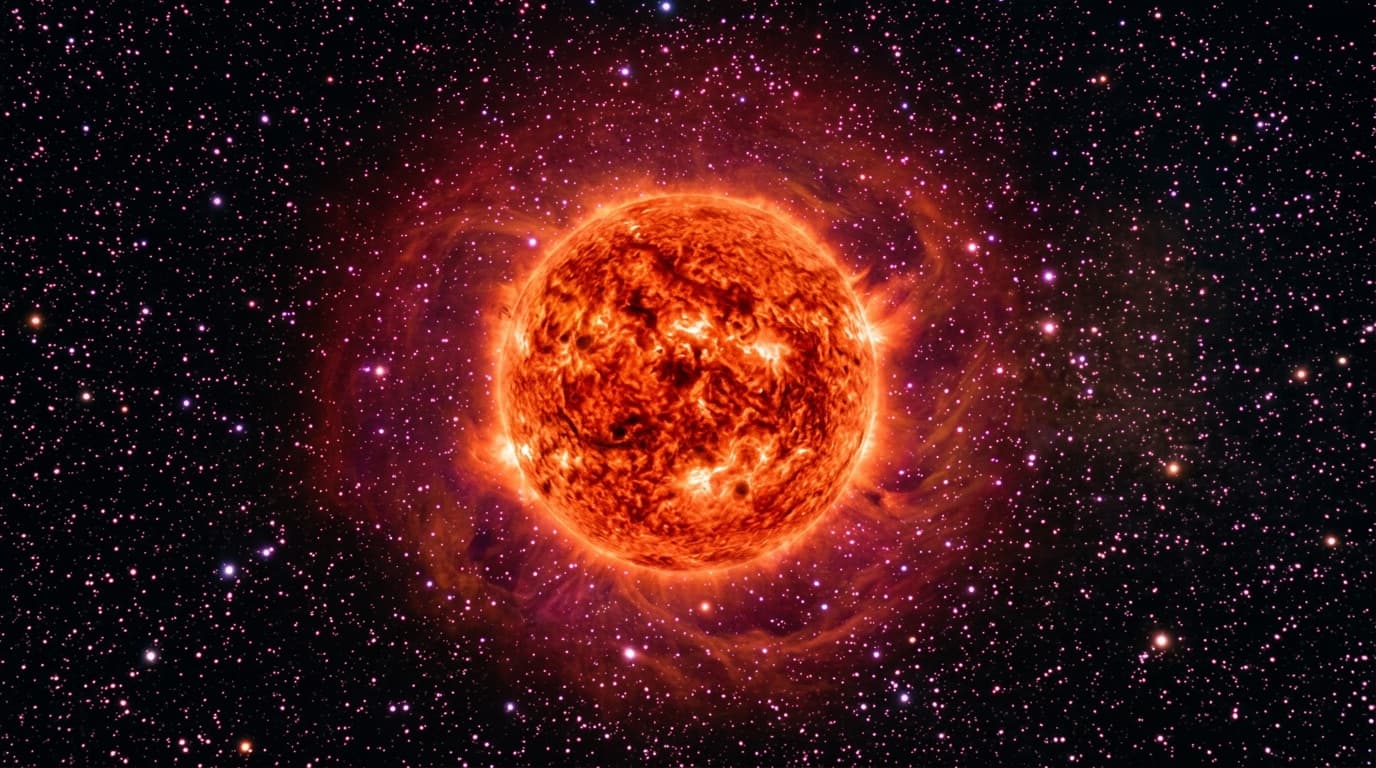
What is Betelgeuse?
Betelgeuse (officially Alpha Orionis) is a red supergiant star located approximately 700 light-years from Earth in the constellation Orion, where it marks the hunter's right shoulder. It is one of the largest stars visible to the naked eye — and one of the most studied in the sky.
Key facts:
• Distance: ~700 light-years (estimates range from 550–700 light-years depending on measurement method)
• Diameter: ~700–1,000 solar diameters — if placed at the center of our solar system, it would engulf everything out to Jupiter
• Mass: ~16–19 solar masses
• Age: ~8–8.5 million years (our Sun, by comparison, is 4.6 billion years old)
• Luminosity: ~100,000 times the luminosity of the Sun
• Surface temperature: ~3,500 K (much cooler than the Sun's 5,778 K — hence the red color)
• Spectral type: M1-M2 Ia-ab (red supergiant)
The name Betelgeuse derives from Arabic: most likely from "Ibt al-Jauzāʾ" — the armpit (or shoulder) of the giant. It is one of the most recognizable stars in the sky, forming the distinctive red shoulder of Orion.
Key facts:
• Distance: ~700 light-years (estimates range from 550–700 light-years depending on measurement method)
• Diameter: ~700–1,000 solar diameters — if placed at the center of our solar system, it would engulf everything out to Jupiter
• Mass: ~16–19 solar masses
• Age: ~8–8.5 million years (our Sun, by comparison, is 4.6 billion years old)
• Luminosity: ~100,000 times the luminosity of the Sun
• Surface temperature: ~3,500 K (much cooler than the Sun's 5,778 K — hence the red color)
• Spectral type: M1-M2 Ia-ab (red supergiant)
The name Betelgeuse derives from Arabic: most likely from "Ibt al-Jauzāʾ" — the armpit (or shoulder) of the giant. It is one of the most recognizable stars in the sky, forming the distinctive red shoulder of Orion.
The Great Dimming and what it told us
Between late 2019 and early 2020, Betelgeuse dimmed dramatically — dropping to about 36% of its normal brightness, the faintest it had been in recorded history. Astronomers called it the "Great Dimming," and for a few months speculation ran high that Betelgeuse might be about to explode.
It didn't. The subsequent scientific investigation revealed something even more fascinating: Betelgeuse had ejected a massive plume of hot plasma from its surface, which cooled into a cloud of dust that temporarily blocked our view. The event was essentially a giant stellar sneeze.
The Great Dimming demonstrated something important: Betelgeuse is actively unstable. Its brightness varies on multiple cycles — a 400-day cycle and a ~2,200-day cycle — driven by convective cells in its enormous, turbulent interior. Some of those convective cells are larger than the entire Sun.
It didn't. The subsequent scientific investigation revealed something even more fascinating: Betelgeuse had ejected a massive plume of hot plasma from its surface, which cooled into a cloud of dust that temporarily blocked our view. The event was essentially a giant stellar sneeze.
The Great Dimming demonstrated something important: Betelgeuse is actively unstable. Its brightness varies on multiple cycles — a 400-day cycle and a ~2,200-day cycle — driven by convective cells in its enormous, turbulent interior. Some of those convective cells are larger than the entire Sun.
Ready to send your own words into the universe? Packages from $29 – printable certificate & live tracker.
Compose your messageThe supernova that's coming
Betelgeuse will explode. This is not speculation — it is the inevitable fate of any star massive enough to have fused its way through hydrogen, helium, carbon, neon, oxygen, and silicon. When the iron core of a massive star can no longer support itself against gravity, it collapses in milliseconds, and the resulting shockwave blows the outer layers into space as a supernova.
The timing is genuinely uncertain. Current estimates range from a few thousand to roughly 100,000 years from now. On cosmic timescales, Betelgeuse is effectively on borrowed time.
When it goes, it will be extraordinary for observers on Earth. At its predicted peak brightness, Betelgeuse could outshine the full Moon and be visible in daylight. It will remain visible to the naked eye for weeks to months before fading, leaving behind an expanding nebula and possibly a neutron star at its core.
Your signal will arrive at Betelgeuse in approximately 700 years. Whether the star still exists at that point is genuinely unknown.
The timing is genuinely uncertain. Current estimates range from a few thousand to roughly 100,000 years from now. On cosmic timescales, Betelgeuse is effectively on borrowed time.
When it goes, it will be extraordinary for observers on Earth. At its predicted peak brightness, Betelgeuse could outshine the full Moon and be visible in daylight. It will remain visible to the naked eye for weeks to months before fading, leaving behind an expanding nebula and possibly a neutron star at its core.
Your signal will arrive at Betelgeuse in approximately 700 years. Whether the star still exists at that point is genuinely unknown.
Why choose Betelgeuse for your message
Betelgeuse carries a unique weight among Cosmic Echo destinations. Every other star in our catalog is stable — burning through its hydrogen with billions of years left ahead of it. Betelgeuse is different. It is near the end of a short, spectacular life. It is dying.
There is something profound about sending a message toward a star that might not exist by the time it arrives. It mirrors certain human experiences — letters to people who have passed, words spoken toward an empty place, gratitude offered too late. The gesture matters independently of whether the recipient is still there to receive it.
Betelgeuse is also the most dramatic star visible to the naked eye from most of Earth's Northern Hemisphere. On clear winter nights, you can look up at Orion, find the red shoulder, and know: your message is already on its way there.
There is something profound about sending a message toward a star that might not exist by the time it arrives. It mirrors certain human experiences — letters to people who have passed, words spoken toward an empty place, gratitude offered too late. The gesture matters independently of whether the recipient is still there to receive it.
Betelgeuse is also the most dramatic star visible to the naked eye from most of Earth's Northern Hemisphere. On clear winter nights, you can look up at Orion, find the red shoulder, and know: your message is already on its way there.
~6 hours
To transmission
Radio signal
Transmission type
299,792 km/s
Signal speed
$29
Digital certificate
Frequently Asked Questions
Everything you need to know
Your words deserve to travel forever
Packages from $29 – printable certificate & live tracker. Your message transmits within hours.
Send Your Message