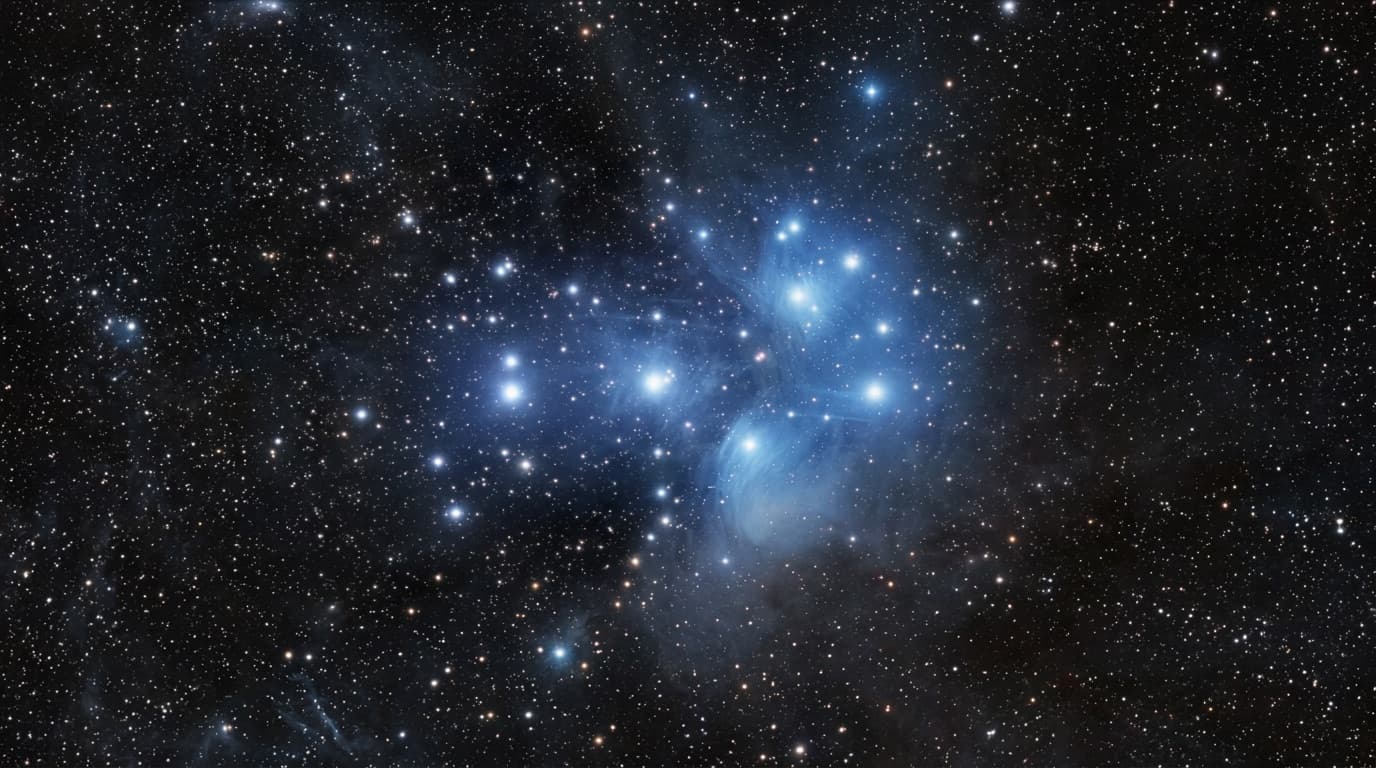
What are the Pleiades?
The Pleiades (M45) are an open star cluster in the constellation Taurus, approximately 444 light-years from Earth. They are the most prominent star cluster in the night sky and one of the closest to our solar system.
Key facts:
• Distance: ~444 light-years
• Number of stars: ~1,000 confirmed members, with 6–7 visible to the naked eye
• Type: Open cluster — stars born from the same molecular cloud, still gravitationally associated
• Age: ~100 million years (young — the Sun is 46× older)
• Dominant stars: Hot blue-white B-type stars, the most luminous of which include Alcyone, Atlas, Electra, Maia, Merope, Taygeta, and Pleione
• Apparent size: About 5 times the angular diameter of the full Moon
The cluster is embedded in a faint reflection nebula — a cloud of gas and dust illuminated by the stars. This nebula (named the Maia Nebula) was initially mistaken for leftover material from the cluster's formation, but is now understood to be unrelated interstellar material that the cluster is currently passing through.
Key facts:
• Distance: ~444 light-years
• Number of stars: ~1,000 confirmed members, with 6–7 visible to the naked eye
• Type: Open cluster — stars born from the same molecular cloud, still gravitationally associated
• Age: ~100 million years (young — the Sun is 46× older)
• Dominant stars: Hot blue-white B-type stars, the most luminous of which include Alcyone, Atlas, Electra, Maia, Merope, Taygeta, and Pleione
• Apparent size: About 5 times the angular diameter of the full Moon
The cluster is embedded in a faint reflection nebula — a cloud of gas and dust illuminated by the stars. This nebula (named the Maia Nebula) was initially mistaken for leftover material from the cluster's formation, but is now understood to be unrelated interstellar material that the cluster is currently passing through.
The most culturally universal stars in the sky
No other cluster of stars appears as frequently in the mythologies, calendars, and literature of unrelated human cultures as the Pleiades. This universality — on every inhabited continent — makes them arguably the most humanly significant stars in the sky.
Ancient Greece: The Seven Sisters of Greek mythology — daughters of the Titan Atlas and the ocean nymph Pleione. Each was transformed into a star: Alcyone, Maia, Electra, Merope, Taygeta, Celaeno, and Asterope. Their acronychal rising in autumn marked the beginning of the sailing season.
Japan: Called Subaru — the same name given to the Japanese automaker, whose logo depicts the six brightest stars of the cluster. The Pleiades appear in the Nihon Shoki (720 AD) and were used for agricultural calendar timing.
India: Known as Krittika — the first lunar mansion (nakshatra) in the ancient Hindu astronomical system. Associated with the fire god Agni and considered one of the most auspicious of the 27 nakshatras.
Aboriginal Australians: Multiple Aboriginal nations across Australia have Pleiades traditions. Several tell a story of the Pleiades as a group of young women being pursued by the stars of Orion — a story that appears independently in Greek mythology as well.
Ancient Egypt: The Pleiades' heliacal rising was associated with the beginning of the agricultural season and appears in astronomical ceiling texts from royal tombs.
The Aztec calendar: The Pleiades crossed the zenith at midnight every 52 years in central Mexico, marking the start of the Aztec New Fire ceremony — one of the most important religious events in their calendar.
The same seven (or six) stars, named and storied independently by cultures who never knew each other existed. Something about the Pleiades speaks to us at a level deeper than any single civilization.
Ancient Greece: The Seven Sisters of Greek mythology — daughters of the Titan Atlas and the ocean nymph Pleione. Each was transformed into a star: Alcyone, Maia, Electra, Merope, Taygeta, Celaeno, and Asterope. Their acronychal rising in autumn marked the beginning of the sailing season.
Japan: Called Subaru — the same name given to the Japanese automaker, whose logo depicts the six brightest stars of the cluster. The Pleiades appear in the Nihon Shoki (720 AD) and were used for agricultural calendar timing.
India: Known as Krittika — the first lunar mansion (nakshatra) in the ancient Hindu astronomical system. Associated with the fire god Agni and considered one of the most auspicious of the 27 nakshatras.
Aboriginal Australians: Multiple Aboriginal nations across Australia have Pleiades traditions. Several tell a story of the Pleiades as a group of young women being pursued by the stars of Orion — a story that appears independently in Greek mythology as well.
Ancient Egypt: The Pleiades' heliacal rising was associated with the beginning of the agricultural season and appears in astronomical ceiling texts from royal tombs.
The Aztec calendar: The Pleiades crossed the zenith at midnight every 52 years in central Mexico, marking the start of the Aztec New Fire ceremony — one of the most important religious events in their calendar.
The same seven (or six) stars, named and storied independently by cultures who never knew each other existed. Something about the Pleiades speaks to us at a level deeper than any single civilization.
Ready to send your own words into the universe? Packages from $29 – printable certificate & live tracker.
Compose your messageA young cluster in a human universe
The Pleiades are approximately 100 million years old — young by stellar standards. The Solar System is 4.6 billion years old. The Pleiades formed 100 million years ago; at that point, non-avian dinosaurs had already gone extinct on Earth, and the Himalayas hadn't yet formed.
The dominant stars are hot, brilliant, and short-lived. B-type stars burn brightly but fast — they will exhaust their fuel and expand into giants within another few hundred million years. The Pleiades cluster is visually spectacular precisely because it is young; its most luminous stars haven't yet aged off the main sequence.
In another 250 million years or so, the cluster will have dispersed — its member stars drifting apart through the galaxy, the gravitational bonds loosening over time. The Seven Sisters are a temporary gathering, like all gatherings.
The dominant stars are hot, brilliant, and short-lived. B-type stars burn brightly but fast — they will exhaust their fuel and expand into giants within another few hundred million years. The Pleiades cluster is visually spectacular precisely because it is young; its most luminous stars haven't yet aged off the main sequence.
In another 250 million years or so, the cluster will have dispersed — its member stars drifting apart through the galaxy, the gravitational bonds loosening over time. The Seven Sisters are a temporary gathering, like all gatherings.
The missing Pleiad
The Pleiades are called the Seven Sisters, but most observers can only see six stars with the naked eye. The "missing" seventh has been a source of folklore across cultures for thousands of years.
Greek mythology offers several explanations: one sister weeps in shame for having married a mortal man (Merope, wife of Sisyphus). Another hides in grief at the fall of Troy (Electra). The star most likely responsible for the discrepancy is Pleione, which is a variable star — it fluctuates in brightness and was likely more visible to ancient observers than it is today.
Another explanation: the star called Celaeno or Asterope may simply be below the threshold of easy naked-eye visibility for most people. Individual variation in visual acuity matters — some people can clearly see seven, others struggle to count five.
Either way, the legend of the seven — and the mystery of the sixth — has echoed through human storytelling for at least 3,000 years of recorded history, and likely much longer before that.
Greek mythology offers several explanations: one sister weeps in shame for having married a mortal man (Merope, wife of Sisyphus). Another hides in grief at the fall of Troy (Electra). The star most likely responsible for the discrepancy is Pleione, which is a variable star — it fluctuates in brightness and was likely more visible to ancient observers than it is today.
Another explanation: the star called Celaeno or Asterope may simply be below the threshold of easy naked-eye visibility for most people. Individual variation in visual acuity matters — some people can clearly see seven, others struggle to count five.
Either way, the legend of the seven — and the mystery of the sixth — has echoed through human storytelling for at least 3,000 years of recorded history, and likely much longer before that.
~6 hours
To transmission
Radio signal
Transmission type
299,792 km/s
Signal speed
$29
Digital certificate
Frequently Asked Questions
Everything you need to know
Your words deserve to travel forever
Packages from $29 – printable certificate & live tracker. Your message transmits within hours.
Send Your Message