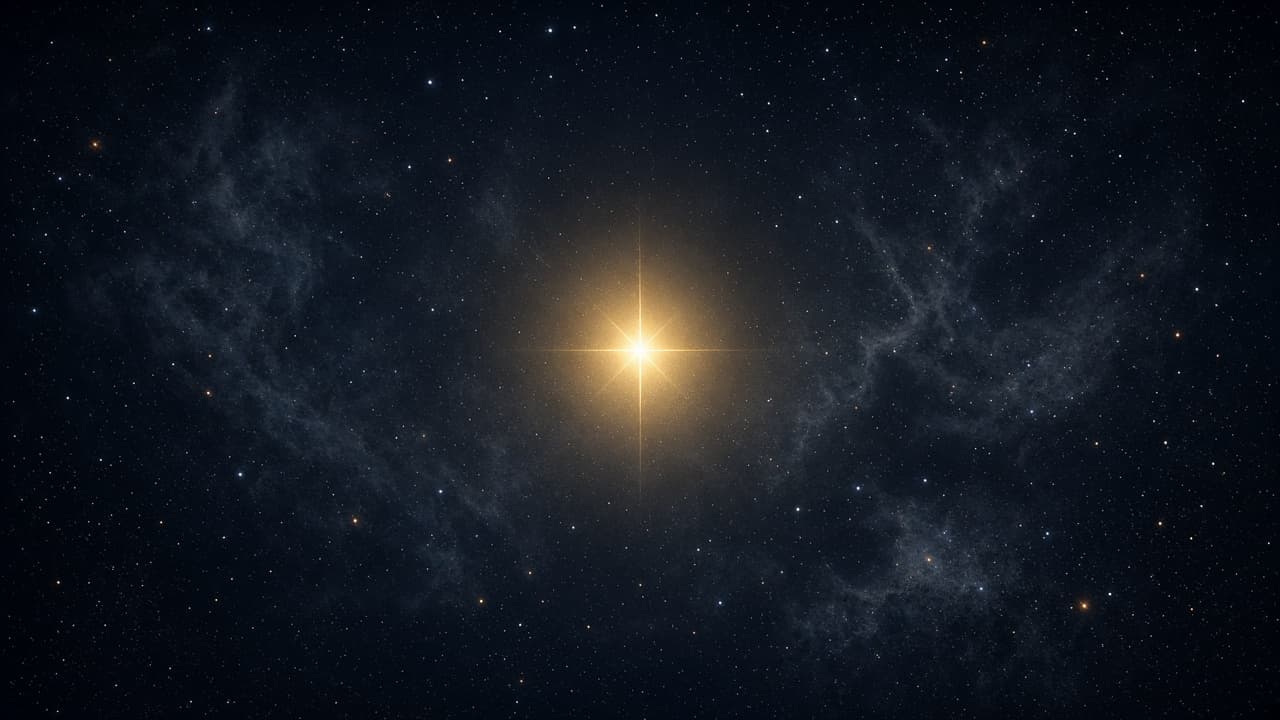
What is Polaris?
Polaris (Alpha Ursae Minoris) is the brightest star in the constellation Ursa Minor, commonly known as the Little Dipper or Little Bear. It is the current North Star — the star that sits almost directly above Earth's geographic North Pole — at a distance of approximately 433 light-years.
Type: F7Ib — a yellow-white supergiant
Mass: Approximately 4.5-6 solar masses
Luminosity: ~2,500 times more luminous than the Sun
Distance: 432.6 light-years
System: Polaris is actually a triple star system — Polaris A (the supergiant), Polaris Ab (a close companion), and Polaris B (a more distant companion visible with small telescopes)
Cepheid variable: Polaris is also a Cepheid variable star — it pulsates in brightness on a 3.97-day cycle, though this variation is too small to notice with the naked eye
Type: F7Ib — a yellow-white supergiant
Mass: Approximately 4.5-6 solar masses
Luminosity: ~2,500 times more luminous than the Sun
Distance: 432.6 light-years
System: Polaris is actually a triple star system — Polaris A (the supergiant), Polaris Ab (a close companion), and Polaris B (a more distant companion visible with small telescopes)
Cepheid variable: Polaris is also a Cepheid variable star — it pulsates in brightness on a 3.97-day cycle, though this variation is too small to notice with the naked eye
The star that guided all of human history
Polaris has occupied a unique position in human civilization for thousands of years. Because Earth's rotational axis points almost directly at Polaris, the star appears to remain fixed in the northern sky while all other stars rotate around it. This made it the single most useful navigational reference in the pre-GPS world.
Phoenician sailors used it to cross the Mediterranean. Arab astronomers called it al-Kaukab al-Shamaliyy — the North Star. Viking navigators crossed the North Atlantic using Polaris. Columbus used it on his transatlantic voyages. Harriet Tubman and the Underground Railroad followed it north. Every army, every navy, every explorer from antiquity to the early 20th century used Polaris to find north.
The North Star is not just an astronomical object — it is a character in the human story. Sending your message there is not just a transmission; it is placing your words at the point in the sky that has oriented human beings for as long as we have looked up.
Phoenician sailors used it to cross the Mediterranean. Arab astronomers called it al-Kaukab al-Shamaliyy — the North Star. Viking navigators crossed the North Atlantic using Polaris. Columbus used it on his transatlantic voyages. Harriet Tubman and the Underground Railroad followed it north. Every army, every navy, every explorer from antiquity to the early 20th century used Polaris to find north.
The North Star is not just an astronomical object — it is a character in the human story. Sending your message there is not just a transmission; it is placing your words at the point in the sky that has oriented human beings for as long as we have looked up.
Ready to send your own words into the universe? Packages from $29 – printable certificate & live tracker.
Compose your messagePolaris won't always be the North Star
Earth's rotational axis wobbles slowly in a process called axial precession — a 25,772-year cycle. Right now, the axis points toward Polaris, making it the North Star. But this has not always been the case, and it will not always be so.
Around 3000 BCE, the North Star was Thuban (in Draco). Around 14,000 CE, the North Star will be Vega. Polaris will again be the North Star in approximately 27,800 CE.
This means we live in a particularly fortunate era — the same star that guided every ancient civilization still guides us. When you send your message to Polaris, you're transmitting to the navigational star of all human history, in the window of time when it still holds that position.
In 25,000 years, when Vega becomes the North Star, your Polaris message will be just arriving at its destination — 433 light-years deep into the past of our own planet's history.
Around 3000 BCE, the North Star was Thuban (in Draco). Around 14,000 CE, the North Star will be Vega. Polaris will again be the North Star in approximately 27,800 CE.
This means we live in a particularly fortunate era — the same star that guided every ancient civilization still guides us. When you send your message to Polaris, you're transmitting to the navigational star of all human history, in the window of time when it still holds that position.
In 25,000 years, when Vega becomes the North Star, your Polaris message will be just arriving at its destination — 433 light-years deep into the past of our own planet's history.
Polaris as a symbol for messages with deep meaning
The navigational significance of Polaris makes it the most symbolically powerful destination for certain kinds of messages:
For memorials — "Find your way home." Polaris has always guided travelers back. A memorial transmission to Polaris carries this meaning in its coordinates.
For children — Parents who send a message to Polaris for a newborn give them something to look up at their whole lives: the one point in the sky that never moves, that has guided every generation before them.
For proposals and declarations — "Wherever we go, I will find my way back to you." Polaris as a metaphor for the person who orients you, who is always north.
For honesty and permanence — Polaris doesn't move. It has been fixed above Earth for all of recorded human history. Some people choose it for that reason alone: a transmission aimed at the one constant in the sky.
For memorials — "Find your way home." Polaris has always guided travelers back. A memorial transmission to Polaris carries this meaning in its coordinates.
For children — Parents who send a message to Polaris for a newborn give them something to look up at their whole lives: the one point in the sky that never moves, that has guided every generation before them.
For proposals and declarations — "Wherever we go, I will find my way back to you." Polaris as a metaphor for the person who orients you, who is always north.
For honesty and permanence — Polaris doesn't move. It has been fixed above Earth for all of recorded human history. Some people choose it for that reason alone: a transmission aimed at the one constant in the sky.
Finding Polaris tonight
Polaris is easy to find from anywhere in the northern hemisphere. The classic method: find the Big Dipper (Ursa Major). The two outermost stars of the Dipper's bowl — Dubhe and Merak — are called the "pointer stars." Draw an imaginary line from Merak through Dubhe and extend it about five times the distance between them. That's Polaris.
Once you've sent your transmission, step outside on a clear night and find that star. It's easy to recognize: it barely moves as the hours pass while every other star rotates around it. Somewhere between you and that fixed point of light, your message is moving. Not rotating. Not going anywhere but forward, at the speed of light, in the exact direction you chose.
Once you've sent your transmission, step outside on a clear night and find that star. It's easy to recognize: it barely moves as the hours pass while every other star rotates around it. Somewhere between you and that fixed point of light, your message is moving. Not rotating. Not going anywhere but forward, at the speed of light, in the exact direction you chose.
~6 hours
To transmission
Radio signal
Transmission type
299,792 km/s
Signal speed
$29
Digital certificate
Frequently Asked Questions
Everything you need to know
Your words deserve to travel forever
Packages from $29 – printable certificate & live tracker. Your message transmits within hours.
Send Your Message